


Fieldwork August 2025
In the August of 2025, Muir Is Tir kicked off the project’s coastal monitoring work with a month of fieldwork on the dunes of Vatersay and Eoligarry. This being the project’s first summer in operation, the goal of this year’s field season was to gather initial baseline data on the plants and soils from each of our sites.
Over the course of a month, Muir Is Tir’s researcher Amanda Vestergaard surveyed a total of 30 plots alongside local volunteers and community groups. After dividing the area into regular sections or what are called transects. We start by throwing a quadrat: a metal rectangular shape that falls where it lands and we take our samples from within the quadrat.

At each plot, a range of information about the dunes and the plants growing there was collected:
- Aboveground biomass, which was dried and sorted by species to give a clear picture of species abundance throughout different sections of dunes
- Below-ground biomass, which was extracted using a 15cm soil core to give a clearer picture of root networks within the dunes
- Percentage vegetation cover
- Soil moisture
- Slope, aspect and curvature of the ground at plot location
- Shear strength at the surface and at 5 cm and 10 cm depth
- Finally, a small soil sample was collected for further analysis at our lab in Glasgow

We need to cut all of the vegetation so we can sort this into different species and wiegh it to tell us how much biomass there is in this spot.

We also take a soil sample to examine the root systems and measure the carbon in the soil.

We also take the temperature of the ground at different levels.
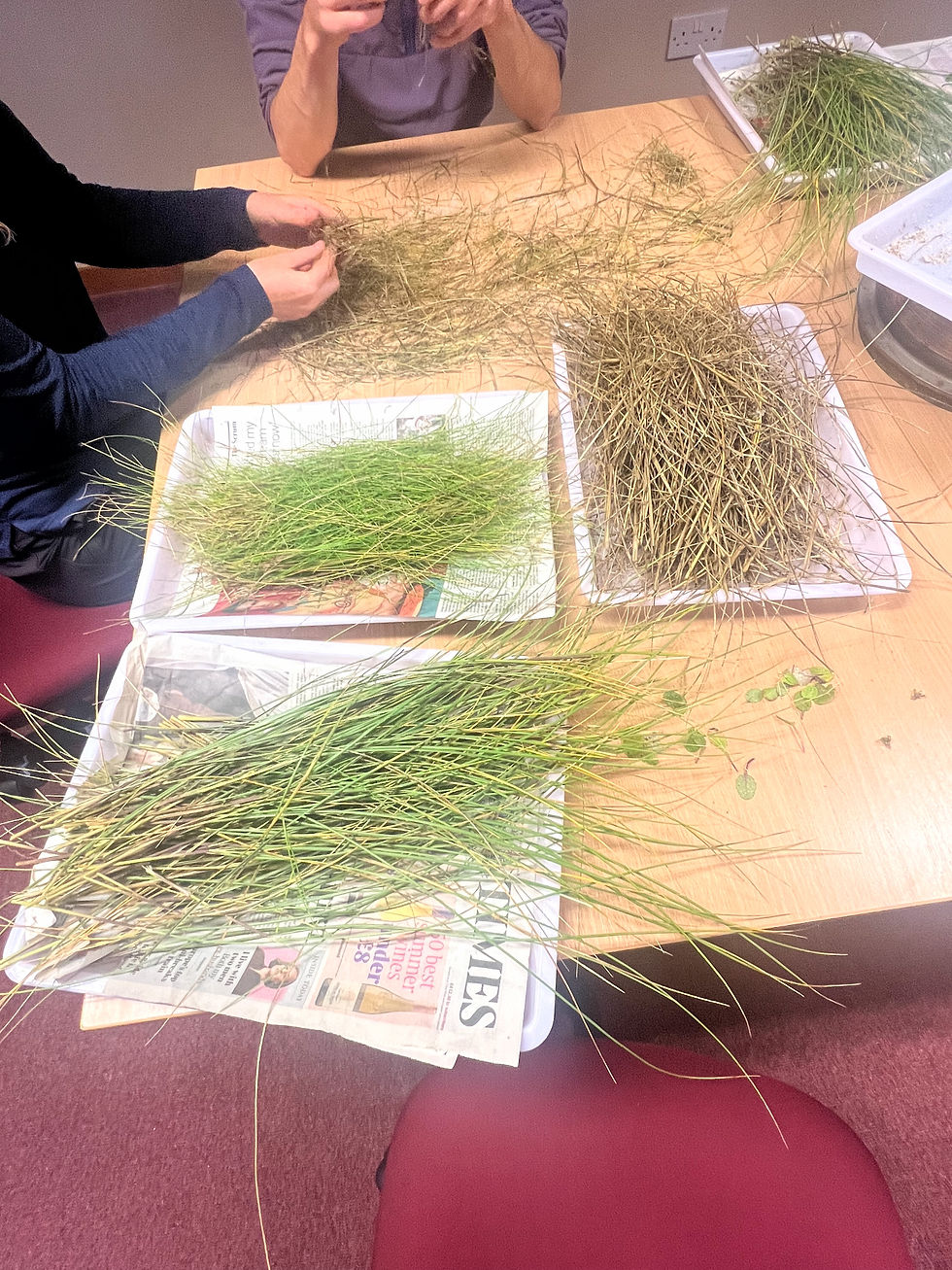
Before going to the lab we sort the various species of plants.
All of this work has given us a valuable set of baseline data on the plants and soils that make up our research sites. This information will help us make better-informed decisions about nature-based coastal management approaches that will be explored and trialled later in the project.
But this summer’s field season was about much more than just the data. It was about spending time together on the land, sharing skills, learning about the dunes, and building local knowledge around coastal ecosystems. Throughout the month, 22 volunteers participated in this work, including community members, visitors, school pupils and learning groups from Barra’s community gardens, Garadh A Bhagh A Tuath.
A huge thank you to everyone who took part – whether you joined us for a day, a week, or just stopped for a chat. We loved having you involved, and we can’t wait to see you all again next field season.


If someone wants to read more about similar topics, you may find something relevant here: https://infowomenspace.com. The site has information on several everyday subjects.